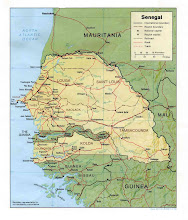
Senegal’s economy will grow about 3.1 percent this year, up from 2.5 percent in 2008, as government management of the economy improves, the International Monetary Fund said.
“Budgetary slippages, which had seriously affected the economy” and put IMF support for Senegal at risk, have been successfully addressed, the Washington-based lender said in an e-mailed statement today. “The government’s unpaid bills have been substantially reduced and far-reaching public financial management reforms launched.”
The IMF expects growth in the west African nation to accelerate to 3.4 percent next year and 4.3 percent in 2011.
Consumer inflation was projected to slow to 3.3 percent this year from 5.8 percent last year, and to 0.8 percent in 2010, as food and fuel price increases slow, the IMF said.
The Wade administration should be credited with helping to effect the fiscal discipline that has got the country straightened out.
Showing posts with label budget. Show all posts
Showing posts with label budget. Show all posts
Monday, July 13, 2009

Tuesday, May 26, 2009
Senegal's fiscal discipline paying off
Senegal's government is starting to see some real benefits for the reforms it has made over the last year to its fiscal policies. Now, Standard & Poor's ratings have improved for Senegal's debt rating, now "B+" in the short-term and "B" for long-term notes. The outlook for government notes changed from "negative" from "stable".
According to the rating agency, the revision reflects "improving the management of public finances," such as progress made in establishing procedures for expenditures, more rigorous budget execution and the ban on cash advances. These improvements are added by statutory payment of arrears (3 percent of GDP in 2008) to suppliers and reducing the budget deficit on the basis of a target of 4 percent in 2009 (including grants) against 7 percent in 2008 (including arrears ). These two measures will help to maintain debt at sustainable levels.
Such discipline now will put Senegal in a strong position when the world economy revives.
According to the rating agency, the revision reflects "improving the management of public finances," such as progress made in establishing procedures for expenditures, more rigorous budget execution and the ban on cash advances. These improvements are added by statutory payment of arrears (3 percent of GDP in 2008) to suppliers and reducing the budget deficit on the basis of a target of 4 percent in 2009 (including grants) against 7 percent in 2008 (including arrears ). These two measures will help to maintain debt at sustainable levels.
Such discipline now will put Senegal in a strong position when the world economy revives.
Friday, April 10, 2009
IMF: backpayments being squared, but tough times ahead
The International Monetary Fund (IMF) concluded recent reviews of Senegal's finances with (for Senegal) high marks for catching up with payments to private contractors. But the April 2 report stressed tough times ahead as the world economy comes to bear.
“Senegal is beginning to experience the effects of the global economic crisis. Main channels of transmission are declining remittances, commodity prices, external demand, and foreign direct investment," according to a statement by Johannes Mueller, IMF Mission Chief for Senegal. He notes positive signs on the horizon: "Declining fuel and food prices are projected to lower inflation to about 1 percent in 2009 and limit Senegal’s import bill, thereby helping contain the external current account deficit."
Despite budget and accounting reforms, falling tax revenues will require deficit spending to continue infrastructure improvments and private contracting, according to the IMF report.
No mention is made of the recent local elections and whether they would chill President Abdoulaye Wade's promotion of intrastructure and private projects. Recently the president reportedly stated his pleas to God that he be allowed to complete infrastucture such as the coastal highway...
“Senegal is beginning to experience the effects of the global economic crisis. Main channels of transmission are declining remittances, commodity prices, external demand, and foreign direct investment," according to a statement by Johannes Mueller, IMF Mission Chief for Senegal. He notes positive signs on the horizon: "Declining fuel and food prices are projected to lower inflation to about 1 percent in 2009 and limit Senegal’s import bill, thereby helping contain the external current account deficit."
Despite budget and accounting reforms, falling tax revenues will require deficit spending to continue infrastructure improvments and private contracting, according to the IMF report.
No mention is made of the recent local elections and whether they would chill President Abdoulaye Wade's promotion of intrastructure and private projects. Recently the president reportedly stated his pleas to God that he be allowed to complete infrastucture such as the coastal highway...
Wednesday, January 14, 2009
Tough love: IMF spanks Dakar budgeting but promises "exogenous shocks" relief
In a report issued yesterday, the International Monetary Fund revealed much about Senegal's fiscal problems over the last year. But, after hard work over the last six months or so, the IMF concludes that Senegal has tackled "extrabudgetary expendi-tures" and nonpayment of its bills, so much so that the IMF approved relief from the IMF's "Exogenous Shocks Fund." Indeed "exogenous shocks"-- the high oil prices and food shortages-- were evidently a big reason for the government's "off-budget" spending, to the detriment of contractors, such as those in Touba that we have posted about before.
The actual report is titled:
"Senegal: Second Review Under the Policy Support Instrument, Request for a Twelve-Month Arrangement Under the Exogenous Shocks Facility, and Request for Waivers and Modification of Assessment Criteria—Staff Report; Staff Statement; Press Release on the Executive Board Discussion; and Statement by the Executive Director for Senegal" and dated January 2009.
Nestled in the economists' jargon are many revelations of what has been happening with Senegal's budget. We'll try to post further, but meanwhile here is one of the conditions the IMF is putting on "exogenous shock" relief, pertaining to an audit of the government's actual indebtedness to its private contractors:
“No payments will be made to the private sector for any extrabudgetary expenditure before the audit has established the nature of claims and specified the goods and services that were provided and their unit cost. To prevent a recurrence of such spending, the government will impose sanctions on employees found to be at fault and apply a discount factor to the claims of private firms that agreed to provide goods or services on unlawful terms. The government will pay claims recognized on the basis of the audit only after authorization by a budget law providing for simultaneous reductions of appropriations for other expenditure items.” (IMF report, page 46, item 26.)
In other words: contractors who do work on the promise of money that hasn't been legally authorized will take their chances.
The actual report is titled:
"Senegal: Second Review Under the Policy Support Instrument, Request for a Twelve-Month Arrangement Under the Exogenous Shocks Facility, and Request for Waivers and Modification of Assessment Criteria—Staff Report; Staff Statement; Press Release on the Executive Board Discussion; and Statement by the Executive Director for Senegal" and dated January 2009.
Nestled in the economists' jargon are many revelations of what has been happening with Senegal's budget. We'll try to post further, but meanwhile here is one of the conditions the IMF is putting on "exogenous shock" relief, pertaining to an audit of the government's actual indebtedness to its private contractors:
“No payments will be made to the private sector for any extrabudgetary expenditure before the audit has established the nature of claims and specified the goods and services that were provided and their unit cost. To prevent a recurrence of such spending, the government will impose sanctions on employees found to be at fault and apply a discount factor to the claims of private firms that agreed to provide goods or services on unlawful terms. The government will pay claims recognized on the basis of the audit only after authorization by a budget law providing for simultaneous reductions of appropriations for other expenditure items.” (IMF report, page 46, item 26.)
In other words: contractors who do work on the promise of money that hasn't been legally authorized will take their chances.
Saturday, November 22, 2008
Senegal congress environmental department budget misses chance to pick up the garbage
Senegal's government cut the budget slightly this year to the Environment Ministry, but not before representatives deplored the state of garbage in the country. The $67.7 million (U.S.) environmental budget approved is down several million from the last adopted budget. Deputies in the National Assembly voiced their concerns that the garbage ringing Senegal's cities is creating a health hazard. The town of Kaolack, in the heart of the country's groundnut crop region voiced special concerns. The government responded that APIX, the foreign investment agency, and the city of Dakar are working on addressing the growing garbage problem as well as the closure of Mbeubeubus, the nation's sole actual landfill... Other environmental concerns such as fisheries and wildfires were noted as affected by the lowered environmental budget. But it is the garbage problem which Senegalese are most concerned about, according to the article Le Quotidien.
Saturday, November 15, 2008
IMF criticises Dakar for its "slow pay" history on infrastructure work
Previous posts have highlighted the Dakar central govern-ment's "slow pay" history on the Touba infrastructure projects. In the euphemistic terminology of the IMF, a statement following last September's report indicates it is aware of the problem:
"The mission evaluated the serious budgetary slippages that were uncovered in early August 2008. They comprise a large stock of unpaid bills to the private sector within the normal budgetary framework that have accumulated over the last few years, as well as past extrabudgetary spending, which, taken together, were inconsistent with the availability of financing and Senegal's macroeconomic circumstances. While a full assessment of the stock of unpaid bills is ongoing, their extent and lack of consis-tency with the budgetary framework warrant strong actions."
More recent posts here note that President Wade's visit to Touba this week was accompanied by some major payment installments on the Chinese infrastructure work there. One wonders however what result will come of the IMF's "full assessment" of the unpaid bills.
"The mission evaluated the serious budgetary slippages that were uncovered in early August 2008. They comprise a large stock of unpaid bills to the private sector within the normal budgetary framework that have accumulated over the last few years, as well as past extrabudgetary spending, which, taken together, were inconsistent with the availability of financing and Senegal's macroeconomic circumstances. While a full assessment of the stock of unpaid bills is ongoing, their extent and lack of consis-tency with the budgetary framework warrant strong actions."
More recent posts here note that President Wade's visit to Touba this week was accompanied by some major payment installments on the Chinese infrastructure work there. One wonders however what result will come of the IMF's "full assessment" of the unpaid bills.
Subscribe to:
Posts (Atom)