Showing posts with label solid waste management. Show all posts
Showing posts with label solid waste management. Show all posts
Saturday, February 21, 2009
Garbage strike hits Dakar
Garbage workers--les ramasseurs d'ordure--in Dakar are on strike, and according to one news source, facing arrests. The workers, employed by the community association of CADAKAR and the French multinational firm Viola, want more pay and better health conditions. Apparently tuberculosis is widespread among the workers and the vaccinations that they receive have not been effective... We noted last year that the demise of the large-scale AMA waste management contract may have been doomed by labor unrest. Since the Italian AMA left town, the French Viola has moved in, at least to the central parts of Dakar. Now apparently it is also running into trouble... Do the garbage workers have a valid grievance? We're told that pay runs only around a couple (U.S.) dollars a day. Of course,the work is hard around the world, good pay or bad... Our sources also tell us that the Dakar labor force is subject to manipulation by political power brokers. The current strike is organized by Le Front unitaire des syndicats du nettoiement. They promise that garbage will pile in the streets if their demands are not met. They want to meet with President Wade to voice their complaints... Senegal's garbage problems have many causes...

Saturday, November 22, 2008
Senegal congress environmental department budget misses chance to pick up the garbage
Senegal's government cut the budget slightly this year to the Environment Ministry, but not before representatives deplored the state of garbage in the country. The $67.7 million (U.S.) environmental budget approved is down several million from the last adopted budget. Deputies in the National Assembly voiced their concerns that the garbage ringing Senegal's cities is creating a health hazard. The town of Kaolack, in the heart of the country's groundnut crop region voiced special concerns. The government responded that APIX, the foreign investment agency, and the city of Dakar are working on addressing the growing garbage problem as well as the closure of Mbeubeubus, the nation's sole actual landfill... Other environmental concerns such as fisheries and wildfires were noted as affected by the lowered environmental budget. But it is the garbage problem which Senegalese are most concerned about, according to the article Le Quotidien.
Friday, April 18, 2008
Inland via the massive Mbeubeus dump
Wednesday, April 16, 2008
Early start to beat the traffic out of Dakar; headed straight for the Mbeubeus (“m-boob-us”) dump/landfill, we decided to skip Saint Louis and head for Touba direct therefrom…
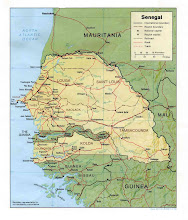
Mbeubeus was all that I had heard—a smoking hell hole, with those making a hellish existence from its dregs. The fellow working his smouldering hole to screen out the metal was a disturbing image, then again maybe it’s just a black-and-white version of Voltaire’s garden. Maybe that’s why they have resisted the government’s attempts to relocate their livelihood. But the reasons why it just can’t work are growing all around the dump. We cruised the area a little and I saw gardeners carrying their metal watering cans up from the groundwater springs to water beautifully green gardens. Maybe the gardens will need to be closed instead of the dump?
I still have quite a few questions about the dump that will require follow up. I didn’t get any means to conduct even an eyeball survey of what was coming in and where it came from. The only trucks I saw on the road in or out were a couple very, very full top load trucks, a hundred or more cubic yards each. I had understood that Canadian or some other researchers were at the landfill but we didn’t try any advance contact and couldn’t find visual directions once there.
The road to Touba was nice. I loved the rural sights, such as the thatched compounds. But there is garbage dumping in large areas blighting that view. Goats can always been seen grazing on a field of garbage. It occurred to me at a point: what would happen if they didn’t have the garbage? Would their livelihood be threatened just like the Mbeubeus scavengers? Almost half of the goats, sheep, and other livestock in Senegal already starve to death.
Theis and Diourbel were nice towns. Diourbel is pretty sleepy; evidently being overshadowed by Mbacke and Touba. Actually Touba is apparently drawing the attention and activity from Mbacke, too… We got to Mbacke about 12:30—it really didn’t take long from Dakar; the road is good. I settled in to a great hotel here with stucco bungalows that look like the circular thatched homes of the rural dwellers. The personnel here are very nice and real. Then we hung out with Mamemor’s extended family. His mom and aunt made lunch. I bought a Baye Fall bou-bou that his nephew made. I met others while we drank lots of café Touba, the strong, sweet dark roast coffee, spiced with diar (“jar”). Before that, while napping at Mamemor’s mom’s place, I caught the Pope’s arrival in the U.S. on CNN; I tried to ignore the silly tired comments that American Catholics are “diverse.” If they were so diverse they wouldn’t be Catholics; nobody is forcing them…
Mustafa and Mamemor’s nephew Mustafa drove me around Mbacke looking at all the garbage around the town… Then back to the hotel. Mamemor brought a fantastic salad, chicken and rice dinner made by his folks before bed. Tomorrow we go into Touba and hopefully meet the Halif (religious leader of the Mourides)…
Early start to beat the traffic out of Dakar; headed straight for the Mbeubeus (“m-boob-us”) dump/landfill, we decided to skip Saint Louis and head for Touba direct therefrom…
Mbeubeus was all that I had heard—a smoking hell hole, with those making a hellish existence from its dregs. The fellow working his smouldering hole to screen out the metal was a disturbing image, then again maybe it’s just a black-and-white version of Voltaire’s garden. Maybe that’s why they have resisted the government’s attempts to relocate their livelihood. But the reasons why it just can’t work are growing all around the dump. We cruised the area a little and I saw gardeners carrying their metal watering cans up from the groundwater springs to water beautifully green gardens. Maybe the gardens will need to be closed instead of the dump?
I still have quite a few questions about the dump that will require follow up. I didn’t get any means to conduct even an eyeball survey of what was coming in and where it came from. The only trucks I saw on the road in or out were a couple very, very full top load trucks, a hundred or more cubic yards each. I had understood that Canadian or some other researchers were at the landfill but we didn’t try any advance contact and couldn’t find visual directions once there.
The road to Touba was nice. I loved the rural sights, such as the thatched compounds. But there is garbage dumping in large areas blighting that view. Goats can always been seen grazing on a field of garbage. It occurred to me at a point: what would happen if they didn’t have the garbage? Would their livelihood be threatened just like the Mbeubeus scavengers? Almost half of the goats, sheep, and other livestock in Senegal already starve to death.
Theis and Diourbel were nice towns. Diourbel is pretty sleepy; evidently being overshadowed by Mbacke and Touba. Actually Touba is apparently drawing the attention and activity from Mbacke, too… We got to Mbacke about 12:30—it really didn’t take long from Dakar; the road is good. I settled in to a great hotel here with stucco bungalows that look like the circular thatched homes of the rural dwellers. The personnel here are very nice and real. Then we hung out with Mamemor’s extended family. His mom and aunt made lunch. I bought a Baye Fall bou-bou that his nephew made. I met others while we drank lots of café Touba, the strong, sweet dark roast coffee, spiced with diar (“jar”). Before that, while napping at Mamemor’s mom’s place, I caught the Pope’s arrival in the U.S. on CNN; I tried to ignore the silly tired comments that American Catholics are “diverse.” If they were so diverse they wouldn’t be Catholics; nobody is forcing them…
Mustafa and Mamemor’s nephew Mustafa drove me around Mbacke looking at all the garbage around the town… Then back to the hotel. Mamemor brought a fantastic salad, chicken and rice dinner made by his folks before bed. Tomorrow we go into Touba and hopefully meet the Halif (religious leader of the Mourides)…
Monday, April 14, 2008
A busy day of business
Monday, April 14, 2008
Started with coffee in the shop downstairs at the President. Had the luck to be invited to sit with Heinz Leuenberger, director of the environmental management branch of the United Nations Industrial Development Organization, based now in Vienna. We had, for me, a very fascinating discussion of international developments, from the changes in Vienna since the opening of East Europe (and the amazing speed with which it has reassumed its role as a cultural capital—Hapsburgs redux), to the looming clash between Russia and China over Eastern Russia, where energy resources, space and cultural affinities may be too great for China to resist. Heinz is here for the big renewable energy conference being held at the hotel all this week…
Mustafa, our driver, was there to take me just as I finished coffee. I made the mistake of leaving my jacket which made Mamemor very unhappy with me, because we were going to meet bankers with some other prospective Senegalese associates. Specifically we met with the charming Oumy Bar Diouf, a “chef d’agence” of Ecobank. The bank, active throughout West Africa, is very interested in expanding its portfolio in the works that we are planning. I believe that I effectively conveyed the applicable principles of non-recourse project financing and available American guarantees. I think she was jazzed. We discussed their loan approval process and possible strategic alliance; I promised to get back to speak with her after doing my informal field analysis and before returning home… We then visited the factory of our associate Mr. Ndiaye, near the oil refinery. I was somewhat disturbed by the lack of worker safety assurance. Mamemor and I later talked at length about how to assure improvements in that aspect for our projects…
Afterwards we met with M. Libasse Niang at his bureau to prepare for our meeting with the minister of agricultural development downtown. The government has an aggressive policy to expand agriculture, recognizing the opportunity to relieve urban overcrowding and promote the economy and welfare of the people at the same time. The downtown this afternoon was busy and active, but we had to cool our heels for a good couple hours before the minister and two of his staff could see us. The minister himself had to beg off early for a meeting with an important Saudi… We all agreed that in the end the meeting was productive; the staff people promising full support for the Cap International project. But it took them a while to understand that this was a private project (which they say they never see) which would ultimately get private, albeit guaranteed, financing—not a handout, not a “gift” from the Saudis or any others, rather a plan to put agriculture in place. Fortunately we had the redoubtable M. Libasse to convey our plans. I have seen many a smooth lobbyist in my day—they are born not made: an engineering contractor by training, M. Libasse is a born lobbyist…
After dropping everybody back at M. Libasse’s bureau, Mamemor and I headed back toward the hotel. We stopped on the way to the restaurant we had been to on Saturday for breakfast; they wouldn’t let Mamemor bring in his own bottled water, so he insisting on leaving. On the way out there were soldiers along the road by the car and the road, usually crowded, was suddenly deserted. Mamemor called it: “the President is probably coming.” And indeed he did with motorcycle cops, sirens, SUVs and limos screaming by. Maybe going to the airport I said. Maybe the President was going to the President hotel, said Mamemor and again he called it exactly. By the time we got to the hotel they were all there, with the presidential guard. I got myself in a picture with one of them—very good uniforms. President Wade ducked out very shortly before we could see him, but Mamemor spotted Dr. Cheikh Tidiane Gadio, the minister of foreign affairs (our Secretary of State). He is very important—Mamemor and I had just been speaking on the way to the hotel of the Senegalese government’s growing importance on the world stage, as not just the broker of West African development (witness the assumption of the trial of the ex-Congo president), but even in matters as paramount as Iranian-American relations (vis President Wade’s meeting with Ahmadinejad this weekend. That said, Dr. Gadio was very accessible and friendly; he had studied in America and spoke English fluently, and as clear evidence of his civility—he let me have a picture with him. Afterwards with Mamemor, I found the restaurant down by the waterfront that I didn’t know about—incredible setting, pricey but worth-it buffet. In the elevator up to the room, I saw Heinz again; he says the President and Senegalese top officials will be speaking at the conference this week… All-in-all a fantastic day and productive day…
Started with coffee in the shop downstairs at the President. Had the luck to be invited to sit with Heinz Leuenberger, director of the environmental management branch of the United Nations Industrial Development Organization, based now in Vienna. We had, for me, a very fascinating discussion of international developments, from the changes in Vienna since the opening of East Europe (and the amazing speed with which it has reassumed its role as a cultural capital—Hapsburgs redux), to the looming clash between Russia and China over Eastern Russia, where energy resources, space and cultural affinities may be too great for China to resist. Heinz is here for the big renewable energy conference being held at the hotel all this week…
Mustafa, our driver, was there to take me just as I finished coffee. I made the mistake of leaving my jacket which made Mamemor very unhappy with me, because we were going to meet bankers with some other prospective Senegalese associates. Specifically we met with the charming Oumy Bar Diouf, a “chef d’agence” of Ecobank. The bank, active throughout West Africa, is very interested in expanding its portfolio in the works that we are planning. I believe that I effectively conveyed the applicable principles of non-recourse project financing and available American guarantees. I think she was jazzed. We discussed their loan approval process and possible strategic alliance; I promised to get back to speak with her after doing my informal field analysis and before returning home… We then visited the factory of our associate Mr. Ndiaye, near the oil refinery. I was somewhat disturbed by the lack of worker safety assurance. Mamemor and I later talked at length about how to assure improvements in that aspect for our projects…
Afterwards we met with M. Libasse Niang at his bureau to prepare for our meeting with the minister of agricultural development downtown. The government has an aggressive policy to expand agriculture, recognizing the opportunity to relieve urban overcrowding and promote the economy and welfare of the people at the same time. The downtown this afternoon was busy and active, but we had to cool our heels for a good couple hours before the minister and two of his staff could see us. The minister himself had to beg off early for a meeting with an important Saudi… We all agreed that in the end the meeting was productive; the staff people promising full support for the Cap International project. But it took them a while to understand that this was a private project (which they say they never see) which would ultimately get private, albeit guaranteed, financing—not a handout, not a “gift” from the Saudis or any others, rather a plan to put agriculture in place. Fortunately we had the redoubtable M. Libasse to convey our plans. I have seen many a smooth lobbyist in my day—they are born not made: an engineering contractor by training, M. Libasse is a born lobbyist…
After dropping everybody back at M. Libasse’s bureau, Mamemor and I headed back toward the hotel. We stopped on the way to the restaurant we had been to on Saturday for breakfast; they wouldn’t let Mamemor bring in his own bottled water, so he insisting on leaving. On the way out there were soldiers along the road by the car and the road, usually crowded, was suddenly deserted. Mamemor called it: “the President is probably coming.” And indeed he did with motorcycle cops, sirens, SUVs and limos screaming by. Maybe going to the airport I said. Maybe the President was going to the President hotel, said Mamemor and again he called it exactly. By the time we got to the hotel they were all there, with the presidential guard. I got myself in a picture with one of them—very good uniforms. President Wade ducked out very shortly before we could see him, but Mamemor spotted Dr. Cheikh Tidiane Gadio, the minister of foreign affairs (our Secretary of State). He is very important—Mamemor and I had just been speaking on the way to the hotel of the Senegalese government’s growing importance on the world stage, as not just the broker of West African development (witness the assumption of the trial of the ex-Congo president), but even in matters as paramount as Iranian-American relations (vis President Wade’s meeting with Ahmadinejad this weekend. That said, Dr. Gadio was very accessible and friendly; he had studied in America and spoke English fluently, and as clear evidence of his civility—he let me have a picture with him. Afterwards with Mamemor, I found the restaurant down by the waterfront that I didn’t know about—incredible setting, pricey but worth-it buffet. In the elevator up to the room, I saw Heinz again; he says the President and Senegalese top officials will be speaking at the conference this week… All-in-all a fantastic day and productive day…
Subscribe to:
Posts (Atom)