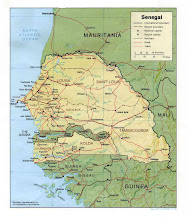
A recent Economist article gives a snapshot of Senegal's political scene with a focus on President Wade... Objectively Senegal is doing pretty good, with credit going to President Wade for positive economic signs such as the Corniche expressway from the airport to downtown and decent communications infrastructure, according to the February 26 article, datelined Dakar without byline.
But the article points to troubling signs from Senegal's political society, much of which it also attributes to the President. Last year's food riots (see our previous posts), and allegations of corruption have generated "rage and frustration" among many Senegalese, according to the article.
The Economist's short article injects some heavy hyperbole: the teaser cites "authoritarian" President Wade and the article's subhead states ominously that: "President Wade will ignore domestic discontent at his peril." This should hardly be news to any politician.
And the article's "taxi-driver" level of analysis misses relevant developments: fortuitous rains and consequent good harvests combined with easing import costs (lower fuel costs) and pending IMF aid will help the country's economic discontent.
Better to sort out the political grumbling after the local elections on March 22. Institutional politics take a backseat in Senegal where personal political ties are more pronounced. That level of political dynamic is beyond the grasp of most observers (including us). And local political elections, as these upcoming, are even more parochial. The losers and disaffected factions from the local elections will make their views known sooner or later. It will take a while to sort out. We intend to be there to get a first hand sense...
Sunday, March 8, 2009

Saturday, February 21, 2009
Garbage strike hits Dakar
Garbage workers--les ramasseurs d'ordure--in Dakar are on strike, and according to one news source, facing arrests. The workers, employed by the community association of CADAKAR and the French multinational firm Viola, want more pay and better health conditions. Apparently tuberculosis is widespread among the workers and the vaccinations that they receive have not been effective... We noted last year that the demise of the large-scale AMA waste management contract may have been doomed by labor unrest. Since the Italian AMA left town, the French Viola has moved in, at least to the central parts of Dakar. Now apparently it is also running into trouble... Do the garbage workers have a valid grievance? We're told that pay runs only around a couple (U.S.) dollars a day. Of course,the work is hard around the world, good pay or bad... Our sources also tell us that the Dakar labor force is subject to manipulation by political power brokers. The current strike is organized by Le Front unitaire des syndicats du nettoiement. They promise that garbage will pile in the streets if their demands are not met. They want to meet with President Wade to voice their complaints... Senegal's garbage problems have many causes...
Wednesday, February 18, 2009
Senegal economy dropped big in 2008; better this year?
The growth of gross domestic product (GDP) of Senegal in 2008 registered a sharp drop, from 4.7 percent in 2007 to only 2.5 percent, according to the Senegal representative of the International Monetary Fund (IMF), Alex Segura. (Who recently had his Dakar apartment burlarized, by the way.)
"Between 1995 and 2005, Senegal has had a growth rate around 5 percent. In 2007 it was 4.7 percent," Segura told Radio France Internationale (RFI).
But "the effect of domestic debt on economic activity was very negative and led to a slowdown in activity in 2008 with a growth rate estimated at 2.5 percent, which is a sharp drop," he said. In 2006, the GDP of Senegal had already been a bad year with 2.4 percent.
In 2008, the secondary sector was severely affected, providers of the state have not been paid on time. Many companies were forced to reduce their activities," he added. According to Segura, the growth of non-agricultural GDP was only 1.5 percent in 2008.
For 2009, the IMF's estimated growth for Senegal is 4 percent.
Regarding the heavy domestic debt, "a third had been paid a week ago. The stock of 225 billion CFA francs (342 million) registered with the authorities, there were still around 150 billion CFA francs," Segura said.
"The Minister of Finance (Abdoulaye Diop) is working to find resources to pay the rest. In the coming weeks, if not all, much will be paid," said the IMF representative.
Good credit means paying your debts. The slow pay policy of Senegal's central government could continue to drag down the economy.
Saturday, February 14, 2009
China and Senegal: sweethearts hook up
They've known each other for about three years. "Mais c’est le grand amour" between China and Senegal. Thus on Saint Valentine's Day it is appropriate that the president of the Republic of China, Hu Jintao, rendezvoused with Abdoulaye Wade, the president of Senegal. According to the L'Observateur the visit marked the growing relationship between the two since Senegal recognized communist China only three years ago. China suspended diplomatic relations with Senegal in 1996 when Senegal had the audacity to formally recognize the democratic Chinese government of Taiwan. Then in 2005, under Wade, Senegal switched to recognizing the communist regime over the democratic, furthering the communists' efforts to freeze the democratic Chinese out of international, and United Nations, recognition... Now the relationship has flowered into "a great love" according to the news reports of Hu's Valentine's Day visit to Dakar... That great love was testified according to sources from both countries by the extensive couplings expected in areas such as the development of Senegal's airlines and other transportation systems, as well as exploitation of hard-to-develop oil reserves in Casamance... The Chinese are already involved in major infrastructure projects in Senegal, particularly in Touba, as we have posted here often. The oil exploitation move is interesting, but not surprising considering China's clear program of developing its own oil sources... Will this "great love" last? One wonders, considering the cultural differences of the pair, especially the religious. Senegal is a land of great faith and the Muslim morality of its people is one of its greatest strengths. China is atheist. One wonders if the relationship is really just one of convenience, or even meretricious...
Wednesday, January 28, 2009
Iran to open Dakar trade center
Iran's presence in Senegal is growing, following on the SenIran plant. This in Tehran Times:
"SHIRAZ – The governor general of Iran’s Fars Province, Mohammadreza Rezazadeh and Senegalese Commerce Minister Mamadou Diop signed a memorandum of understanding on late Monday in which Iran agreed to build a trade center in Dakar.
"According to Mehr News Agency, Rezazadeh called Senegal an entrance gate to Africa’s markets.
"He added that during his last visit to Senegal, Shiraz’s private sector successfully formed a trade consortium in the African country that would help promote trade between Senegal and the Iranian province.
"Diop welcomed the promotion of bilateral trade ties, saying that Senegal lacks modern industries and is in need of the latest technology."
Wednesday, January 14, 2009
Tough love: IMF spanks Dakar budgeting but promises "exogenous shocks" relief
In a report issued yesterday, the International Monetary Fund revealed much about Senegal's fiscal problems over the last year. But, after hard work over the last six months or so, the IMF concludes that Senegal has tackled "extrabudgetary expendi-tures" and nonpayment of its bills, so much so that the IMF approved relief from the IMF's "Exogenous Shocks Fund." Indeed "exogenous shocks"-- the high oil prices and food shortages-- were evidently a big reason for the government's "off-budget" spending, to the detriment of contractors, such as those in Touba that we have posted about before.
The actual report is titled:
"Senegal: Second Review Under the Policy Support Instrument, Request for a Twelve-Month Arrangement Under the Exogenous Shocks Facility, and Request for Waivers and Modification of Assessment Criteria—Staff Report; Staff Statement; Press Release on the Executive Board Discussion; and Statement by the Executive Director for Senegal" and dated January 2009.
Nestled in the economists' jargon are many revelations of what has been happening with Senegal's budget. We'll try to post further, but meanwhile here is one of the conditions the IMF is putting on "exogenous shock" relief, pertaining to an audit of the government's actual indebtedness to its private contractors:
“No payments will be made to the private sector for any extrabudgetary expenditure before the audit has established the nature of claims and specified the goods and services that were provided and their unit cost. To prevent a recurrence of such spending, the government will impose sanctions on employees found to be at fault and apply a discount factor to the claims of private firms that agreed to provide goods or services on unlawful terms. The government will pay claims recognized on the basis of the audit only after authorization by a budget law providing for simultaneous reductions of appropriations for other expenditure items.” (IMF report, page 46, item 26.)
In other words: contractors who do work on the promise of money that hasn't been legally authorized will take their chances.
Thursday, January 1, 2009
President Wade: "Happy economic new year!!"
Senegal's President Abdoulaye Wade used his New Year's Eve message to the county to highlight bold economic initiatives out of the daunting climate of the last year. Noting the "off budget" expenditures that the World Bank found fault with, President Wade still claimed that Senegal was the World Bank's highest rated economy.
The president pointed to the launching of Air Teranga, a Senegalese airline, new universities at St. Louis and Kedougou, and the regional port facilities with free market zones and surface connections to Mali and elsewhere in the region. Other infrastructure lurches fitfully ahead at the turn of the year. "If I were to list these projects, it would take much time, I gave instructions to ministers to publish a table with a list of infrastructure to be carried out in 2009" he said. Of course, the World Bank in its requirements to put Senegal back on its approved list required that the country list all such major projects--necessary to get a grip on the off-budget spending and commitments...
It was a detailed speech with a certain Senegalese optimism throughout. The president didn't shy from most of the nation's problems: high gas prices, energy outages, food insecurity. But he was able to point to activities to deal with the problems, especially in the area of agriculture. Fortuitous good harvests help, too. But so do tractors from India and increasing sophistication in the country's animal husbandry... Recent riots in the hinterlands were largely ignored however...
Subscribe to:
Posts (Atom)