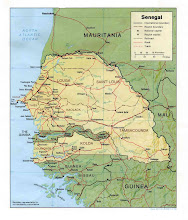
Iran's presence in Senegal is growing, following on the SenIran plant. This in Tehran Times:
"SHIRAZ – The governor general of Iran’s Fars Province, Mohammadreza Rezazadeh and Senegalese Commerce Minister Mamadou Diop signed a memorandum of understanding on late Monday in which Iran agreed to build a trade center in Dakar.
"According to Mehr News Agency, Rezazadeh called Senegal an entrance gate to Africa’s markets.
"He added that during his last visit to Senegal, Shiraz’s private sector successfully formed a trade consortium in the African country that would help promote trade between Senegal and the Iranian province.
"Diop welcomed the promotion of bilateral trade ties, saying that Senegal lacks modern industries and is in need of the latest technology."
Wednesday, January 28, 2009

Wednesday, January 14, 2009
Tough love: IMF spanks Dakar budgeting but promises "exogenous shocks" relief
In a report issued yesterday, the International Monetary Fund revealed much about Senegal's fiscal problems over the last year. But, after hard work over the last six months or so, the IMF concludes that Senegal has tackled "extrabudgetary expendi-tures" and nonpayment of its bills, so much so that the IMF approved relief from the IMF's "Exogenous Shocks Fund." Indeed "exogenous shocks"-- the high oil prices and food shortages-- were evidently a big reason for the government's "off-budget" spending, to the detriment of contractors, such as those in Touba that we have posted about before.
The actual report is titled:
"Senegal: Second Review Under the Policy Support Instrument, Request for a Twelve-Month Arrangement Under the Exogenous Shocks Facility, and Request for Waivers and Modification of Assessment Criteria—Staff Report; Staff Statement; Press Release on the Executive Board Discussion; and Statement by the Executive Director for Senegal" and dated January 2009.
Nestled in the economists' jargon are many revelations of what has been happening with Senegal's budget. We'll try to post further, but meanwhile here is one of the conditions the IMF is putting on "exogenous shock" relief, pertaining to an audit of the government's actual indebtedness to its private contractors:
“No payments will be made to the private sector for any extrabudgetary expenditure before the audit has established the nature of claims and specified the goods and services that were provided and their unit cost. To prevent a recurrence of such spending, the government will impose sanctions on employees found to be at fault and apply a discount factor to the claims of private firms that agreed to provide goods or services on unlawful terms. The government will pay claims recognized on the basis of the audit only after authorization by a budget law providing for simultaneous reductions of appropriations for other expenditure items.” (IMF report, page 46, item 26.)
In other words: contractors who do work on the promise of money that hasn't been legally authorized will take their chances.
The actual report is titled:
"Senegal: Second Review Under the Policy Support Instrument, Request for a Twelve-Month Arrangement Under the Exogenous Shocks Facility, and Request for Waivers and Modification of Assessment Criteria—Staff Report; Staff Statement; Press Release on the Executive Board Discussion; and Statement by the Executive Director for Senegal" and dated January 2009.
Nestled in the economists' jargon are many revelations of what has been happening with Senegal's budget. We'll try to post further, but meanwhile here is one of the conditions the IMF is putting on "exogenous shock" relief, pertaining to an audit of the government's actual indebtedness to its private contractors:
“No payments will be made to the private sector for any extrabudgetary expenditure before the audit has established the nature of claims and specified the goods and services that were provided and their unit cost. To prevent a recurrence of such spending, the government will impose sanctions on employees found to be at fault and apply a discount factor to the claims of private firms that agreed to provide goods or services on unlawful terms. The government will pay claims recognized on the basis of the audit only after authorization by a budget law providing for simultaneous reductions of appropriations for other expenditure items.” (IMF report, page 46, item 26.)
In other words: contractors who do work on the promise of money that hasn't been legally authorized will take their chances.
Thursday, January 1, 2009
President Wade: "Happy economic new year!!"
Senegal's President Abdoulaye Wade used his New Year's Eve message to the county to highlight bold economic initiatives out of the daunting climate of the last year. Noting the "off budget" expenditures that the World Bank found fault with, President Wade still claimed that Senegal was the World Bank's highest rated economy.
The president pointed to the launching of Air Teranga, a Senegalese airline, new universities at St. Louis and Kedougou, and the regional port facilities with free market zones and surface connections to Mali and elsewhere in the region. Other infrastructure lurches fitfully ahead at the turn of the year. "If I were to list these projects, it would take much time, I gave instructions to ministers to publish a table with a list of infrastructure to be carried out in 2009" he said. Of course, the World Bank in its requirements to put Senegal back on its approved list required that the country list all such major projects--necessary to get a grip on the off-budget spending and commitments...
It was a detailed speech with a certain Senegalese optimism throughout. The president didn't shy from most of the nation's problems: high gas prices, energy outages, food insecurity. But he was able to point to activities to deal with the problems, especially in the area of agriculture. Fortuitous good harvests help, too. But so do tractors from India and increasing sophistication in the country's animal husbandry... Recent riots in the hinterlands were largely ignored however...
The president pointed to the launching of Air Teranga, a Senegalese airline, new universities at St. Louis and Kedougou, and the regional port facilities with free market zones and surface connections to Mali and elsewhere in the region. Other infrastructure lurches fitfully ahead at the turn of the year. "If I were to list these projects, it would take much time, I gave instructions to ministers to publish a table with a list of infrastructure to be carried out in 2009" he said. Of course, the World Bank in its requirements to put Senegal back on its approved list required that the country list all such major projects--necessary to get a grip on the off-budget spending and commitments...
It was a detailed speech with a certain Senegalese optimism throughout. The president didn't shy from most of the nation's problems: high gas prices, energy outages, food insecurity. But he was able to point to activities to deal with the problems, especially in the area of agriculture. Fortuitous good harvests help, too. But so do tractors from India and increasing sophistication in the country's animal husbandry... Recent riots in the hinterlands were largely ignored however...
Monday, December 15, 2008
Public concern raised regarding "pots of wine" (bribes) in Senegal
An article in today's SudQuotidien expressed public concern over Senegal's drop on the 2008 "corruption index" produced by Transparency International. Although Senegal is not among the most corrupt on the index, its position fell considerably on the 2008 index...
Construction companies and public works of major exporting countries in Senegal "are identified as most likely to pay bribes to the authorities of host countries," according to the 2008 corruption index. One way to understand the increase in "pots-de-vin" (bribes) is the source of bribes. Transparency International also indexed the countries with the companies most likely to offer bribes. The worst, in order, were Russia, China, Mexico and India.
Senegal does significant business with both China and India. China is engaged in major infrastructure projects, especially around Touba. As we have noted before, India's trade with Senegal has skyrocked in the last five years to lead all others.
The solution Transparency International recommends is, naturally, transparency. Major bidding processes and results should be made public. It cited recent mining deals as an example.
The SudQuotidien article calls increasing corruption a "trap." Rightly so. The well known corrolary to the corruption index is the poverty index--the more corruption, the less likely that a country will develop economically.
Construction companies and public works of major exporting countries in Senegal "are identified as most likely to pay bribes to the authorities of host countries," according to the 2008 corruption index. One way to understand the increase in "pots-de-vin" (bribes) is the source of bribes. Transparency International also indexed the countries with the companies most likely to offer bribes. The worst, in order, were Russia, China, Mexico and India.
Senegal does significant business with both China and India. China is engaged in major infrastructure projects, especially around Touba. As we have noted before, India's trade with Senegal has skyrocked in the last five years to lead all others.
The solution Transparency International recommends is, naturally, transparency. Major bidding processes and results should be made public. It cited recent mining deals as an example.
The SudQuotidien article calls increasing corruption a "trap." Rightly so. The well known corrolary to the corruption index is the poverty index--the more corruption, the less likely that a country will develop economically.
Monday, December 8, 2008
Groundnut harvest way up; a welcome relief for Senegal farmers
Dec. 8 (Bloomberg) -- Peanut production in Senegal will probably increase 66 percent to 550,000 metric tons in the 2008-09 season after plantings increased, according to the U.S. Department of Agriculture.
Output fell 28 percent to 331,200 tons in the 2007-08 season, from the previous year, because of poor rainfall, the department’s Foreign Agricultural Service said on its Web site.
Peanuts are the primary cash crop and source of income for most Senegalese farmers, according to the FAS.
Output fell 28 percent to 331,200 tons in the 2007-08 season, from the previous year, because of poor rainfall, the department’s Foreign Agricultural Service said on its Web site.
Peanuts are the primary cash crop and source of income for most Senegalese farmers, according to the FAS.
Iran and Senegal launch SENIRAN auto assembly plant in Senegal
Iran Khodro, the biggest automobile producer in the Middle East has inaugurated a new assembly plant in the African country of Senegal.
Senegalese president, Abdoulaye Wade, asked for Iran Khodro cars, Bardo pick-up and Peugeot Roa besides Samand passenger car to be produced in SENIRAN AUTO and be exported to the West African countries, said IKCO CEO and president, Manouchehr Manteghi.
During the inauguration ceremony of SENIRAN AUTO in Senegal Manteghi emphasized: Considering Iran Khodro’s strategic plans for its global sales, Central Asian, Middle Eastern and North and West African countries are our points of interest. Senegal’s special position in the region, neighboring seven countries with political an economical ties helped us to make up our mind for establishing a site in this country.
Mentioning that this production line is not a uni-functional one, he added: Right now, Samand passenger car under the name of "Mandory" is produced in this site; however Bardo pick-up, Peugeot Roa, and Pars can also be produced by this assembly line if needed.
Referring to IKCO's car making site in Senegal, Manteghi claimed that foreign companies have already announced their willingness for manufacturing their products in this site.
Renewing public transportation in Senegal has been one of the sources of interest for Senegal's government based on which 2000 Samand made their way to this country, he added. According to Manteghi, around $60 million have been invested on Samand assembly site in Senegal with Iran Khodro and Senegalese government and private sector together putting in 60 and 40 percent respectively.
It's noteworthy that Iran Khodro has established one of the biggest after-sale service centers in Senegal.
Senegalese president, Abdoulaye Wade, asked for Iran Khodro cars, Bardo pick-up and Peugeot Roa besides Samand passenger car to be produced in SENIRAN AUTO and be exported to the West African countries, said IKCO CEO and president, Manouchehr Manteghi.
During the inauguration ceremony of SENIRAN AUTO in Senegal Manteghi emphasized: Considering Iran Khodro’s strategic plans for its global sales, Central Asian, Middle Eastern and North and West African countries are our points of interest. Senegal’s special position in the region, neighboring seven countries with political an economical ties helped us to make up our mind for establishing a site in this country.
Mentioning that this production line is not a uni-functional one, he added: Right now, Samand passenger car under the name of "Mandory" is produced in this site; however Bardo pick-up, Peugeot Roa, and Pars can also be produced by this assembly line if needed.
Referring to IKCO's car making site in Senegal, Manteghi claimed that foreign companies have already announced their willingness for manufacturing their products in this site.
Renewing public transportation in Senegal has been one of the sources of interest for Senegal's government based on which 2000 Samand made their way to this country, he added. According to Manteghi, around $60 million have been invested on Samand assembly site in Senegal with Iran Khodro and Senegalese government and private sector together putting in 60 and 40 percent respectively.
It's noteworthy that Iran Khodro has established one of the biggest after-sale service centers in Senegal.
The Khalife guarantees that Touba work continues
The massive intrastructure and public improvements underway in Touba continue, according to the Khalife of the Mourides, by way of a news report. He assures that the water system infrastructure and other projects were never stalled.
The Khalife, Serigne Mouhamadou Lamine Bara Mbacké, took efforts to emphasize the cooperation of the Holy City with the President of Senegal, Abdoulaye Wade:
"The water project has started. Again, we are in step with the president because he had given the sum of seven billion CFA francs. Then he comes back three and a half billion for drilling, pipes, fountains throughout the city."
Addressing reports that the work had been stopped for lack of funding, the Khalife was reported to state: "The work has never been suspended. Those who say they do not know anything."
Since President Wade showed up with the payments in his recent visit to Touba, relations with the Holy City appear to have warmed up considerably. This at a time when the president is facing political opposition.
The Khalife, Serigne Mouhamadou Lamine Bara Mbacké, took efforts to emphasize the cooperation of the Holy City with the President of Senegal, Abdoulaye Wade:
"The water project has started. Again, we are in step with the president because he had given the sum of seven billion CFA francs. Then he comes back three and a half billion for drilling, pipes, fountains throughout the city."
Addressing reports that the work had been stopped for lack of funding, the Khalife was reported to state: "The work has never been suspended. Those who say they do not know anything."
Since President Wade showed up with the payments in his recent visit to Touba, relations with the Holy City appear to have warmed up considerably. This at a time when the president is facing political opposition.
Subscribe to:
Posts (Atom)