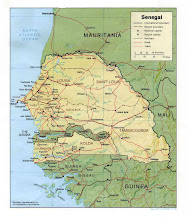
Transportation spending in Senegal has increased much in recent years with road projects like the Cornice and toll roads around Dakar. But keeping up roads across Senegal is underfunded by 50 percent, according to a recent meeting of Senegal business school and government leaders.
Transportation is a key economic development infrastructure. Administrative chief of the Directorate of Land Transport, Papa Souleymane Faye, one of the organizers of the conference, fears new road construction comes at the cost of overall system maintenance. Aging roads and bottlenecks are a growing feature.
One wonders whether Senegal has a capital maintenance program for its roads, adopted by most municipalities in the United States. Many American cities and counties have sophisticated computerized road maintenance programs. But regardless of the sophistication, it ultimately takes money to get it done...
Friday, May 29, 2009

Tuesday, May 26, 2009
Senegal's fiscal discipline paying off
Senegal's government is starting to see some real benefits for the reforms it has made over the last year to its fiscal policies. Now, Standard & Poor's ratings have improved for Senegal's debt rating, now "B+" in the short-term and "B" for long-term notes. The outlook for government notes changed from "negative" from "stable".
According to the rating agency, the revision reflects "improving the management of public finances," such as progress made in establishing procedures for expenditures, more rigorous budget execution and the ban on cash advances. These improvements are added by statutory payment of arrears (3 percent of GDP in 2008) to suppliers and reducing the budget deficit on the basis of a target of 4 percent in 2009 (including grants) against 7 percent in 2008 (including arrears ). These two measures will help to maintain debt at sustainable levels.
Such discipline now will put Senegal in a strong position when the world economy revives.
Friday, May 1, 2009
Karim Wade takes critical infrastructure ministry
Karim Wade has been appointed the "go to" guy for infrastructure in the Wade government. With the appointment by President Wade, he and his son appear to have shaken off the defeats of last month's local elections.
The junior Wade takes the title of Minister for Transportation and Infrastructure. The appointment is a natural fit for the front man of Senegal's "Concrete Generation" movement. The eager-beaver apparatchiks of the Generation de concrete have pushed modern world infrastructure in Senegal.
The newly minted minister's top priority is sure to be the flightless Air Senegal, its crumbled partnership with Royal Air Morac threatening to ground the national airline permanently, even as the new Dakar airport gets going.
Karim's new job is arguably the most significant in Senegal government. Karim Wade's success or failure will impact on Senegal's quest to be the capital of West Africa.
Saturday, April 25, 2009
Air Senegal grounded
Air Senegal International (ASI) has stopped operations as a row between the Senegalese state and majority shareholder Royal Air Maroc (RAM) has grounded all remaining flights, the Moroccan airline said on Friday.
RAM, which owns 51 percent of ASI and had provided several aircraft, recalled its last plane from the airline's fleet earlier this month, leaving ASI, one of West Africa's few reliable carriers, with just two operating planes.
RAM criticised Senegal for the country's unilateral decision in 2007 to take majority control of the airline, a move that has not yet materialised. RAM also says Senegal owes the company about 4 million euros.
RAM has taken a "you want it, you can have it" posture lately, adopting an orderly but insistent withdrawal from the company.
Sunday, April 19, 2009
Iran and Senegal agree to expanded ties
Iran continues to expand its economic links with Senegal. A memorandum of understanding was reportedly executed today obliging the Islamic Republic of Iran to cooperate with Senegal in producing auto diesel, undertaking mine exploration, producing machinery and constructing power plants.
Iran has made good on its intentions to expand economic and cultural ties with Senegal. Trade ministers inking todays agreement pointed to the construction of the giant auto manufacturer Iran Khodro's assembly plant in Senegal. The agreement appears to build on that venture.
Iran has made good on its intentions to expand economic and cultural ties with Senegal. Trade ministers inking todays agreement pointed to the construction of the giant auto manufacturer Iran Khodro's assembly plant in Senegal. The agreement appears to build on that venture.
Offshore oil exploration not the first time for Senegal
The recent spike in oil prices has revived interest in exploration off the Senegal's coast. Here's a good overview of past exploration activities:
In the last 48 years, more than 144 hydrocarbon exploration wells have been drilled in Senegalese territory. At least 49 of these drilled offshore, with 23 of these being located in the Casamance Offshore. The other area of interest that has been drilled is onshore in the vicinity of the Cape Vert Peninsula. The rest of the Senegal Basin outside these areas remains under-explored.
In addition, modern analysis indicates that many of the boreholes drilled, particularly those based on seismic information acquired before 1962, were poorly located in prospects and many were limited to exploration of the Tertiary to Senonian intervals.
The upstream oil industry is becoming increasingly important to the Senegalese economy. In 1981, PETROSEN, the national oil company, was created by the government of Senegal and is responsible for all hydrocarbon exploration activities.
During the 1950s petroleum prospecting started and in the 1960s and 1970s a number of small fields were discovered, but found uneconomical not exploited. In the late 1970s, offshore exploration started again and a field of heavy crude oil of 1 billion barrels was discovered. So far only one gas field (Diam Niadio 14) has been discovered. The gas is exported by pipeline to the Societe Nationale d'Electricite for its gas power stations. Current gas reserves are estimated to be 3 billion cubic metres. According to the US Department of Energy, Senegal produced and consumed 1.4 billion barrels of dry gas.
The offshore border area containing the Dome Flore and Gea fields became the subject of dispute between Senegal and Guinea-Bissau. In 1993, the Agence de Gestion et de Cooperation entre la Guinea-Bissau et le Senegal (AGC) was established as a joint commission to oversee oil and gas exploration and fishing in the disputed area between the Senegal and Guinea-Bissau.
In July 2004 Hunt Oil Company, through its wholly owned subsidiary Senegal Hunt Oil Company, signed an agreement with Petrosen (Petroleum Company of Senegal), giving Hunt the exclusive right to carry out petroleum exploration and production operations in Sangomar-Rufisque Offshore Area of Senegal (approximately 3,701,805 square acres).
Energy Africa acquired the St. Louis exploration licence with Petrosen in late 2003. Tullow operates the licence with a 60 percent interest. Dana acquired a 30 percent interest from Tullow in the fourth quarter of 2004. Petrosen holds the remaining 10 percent.
In March 2005 Sterling signed a farm-out deal with Markmore Energy (L) Ltd, a private oil and gas company wholly owned by investor Tan Sri Halim Saad for the Dome Flore offshore petroleum license held by Sterling. The Dome Flore block offshore Senegal and Guinea Bissau, contains an estimated 800 million barrels of heavy oil in place. The discoveries lie in 50 metres of water, approximately 70 km offshore.
Friday, April 17, 2009
A new Senegal energy source: openness
A unique solution to Senegal's energy dilemma was recommended recently by Alex Segura, the IMF's resident representative. The solution is two part: cash and transparency. And the two go together. Senegal's utilities are stuck in a spot market rut: they buy fuel oil one tanker at a time, in cash, frequently borrowed cash, from who-knows-where... Instead Segura urges transparent bidding. International finance experts have always pushed open bidding in African economies, with little progress. In the energy sector it makes sense, but is no easier than other sectors such as infrastructure. Oil powers Senegal's feeble generation capacity. That's imported, refined oil--especially subject to the world extaction, refining and transportation market, and its very evident vagaries, especially recently... It will take some real arm twisting for Senegal's utility sector (hardly deserving the name) to institute the discipline, and smarts, necessary for a successful open bidding program. But the payoffs would seem great: the consequent tools of hedge and option trading of supplies could create a buffer in hard economic times as these... Segura's recent comments were larded with praise for the progress being made by Senegal's establishment in the area of budget reform and accountability, setting the foundation for sophistication in its energy policies and practices...
Subscribe to:
Posts (Atom)