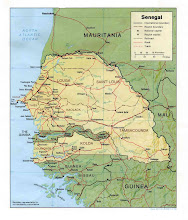
The recent spike in oil prices has revived interest in exploration off the Senegal's coast. Here's a good overview of past exploration activities:
In the last 48 years, more than 144 hydrocarbon exploration wells have been drilled in Senegalese territory. At least 49 of these drilled offshore, with 23 of these being located in the Casamance Offshore. The other area of interest that has been drilled is onshore in the vicinity of the Cape Vert Peninsula. The rest of the Senegal Basin outside these areas remains under-explored.
In addition, modern analysis indicates that many of the boreholes drilled, particularly those based on seismic information acquired before 1962, were poorly located in prospects and many were limited to exploration of the Tertiary to Senonian intervals.
The upstream oil industry is becoming increasingly important to the Senegalese economy. In 1981, PETROSEN, the national oil company, was created by the government of Senegal and is responsible for all hydrocarbon exploration activities.
During the 1950s petroleum prospecting started and in the 1960s and 1970s a number of small fields were discovered, but found uneconomical not exploited. In the late 1970s, offshore exploration started again and a field of heavy crude oil of 1 billion barrels was discovered. So far only one gas field (Diam Niadio 14) has been discovered. The gas is exported by pipeline to the Societe Nationale d'Electricite for its gas power stations. Current gas reserves are estimated to be 3 billion cubic metres. According to the US Department of Energy, Senegal produced and consumed 1.4 billion barrels of dry gas.
The offshore border area containing the Dome Flore and Gea fields became the subject of dispute between Senegal and Guinea-Bissau. In 1993, the Agence de Gestion et de Cooperation entre la Guinea-Bissau et le Senegal (AGC) was established as a joint commission to oversee oil and gas exploration and fishing in the disputed area between the Senegal and Guinea-Bissau.
In July 2004 Hunt Oil Company, through its wholly owned subsidiary Senegal Hunt Oil Company, signed an agreement with Petrosen (Petroleum Company of Senegal), giving Hunt the exclusive right to carry out petroleum exploration and production operations in Sangomar-Rufisque Offshore Area of Senegal (approximately 3,701,805 square acres).
Energy Africa acquired the St. Louis exploration licence with Petrosen in late 2003. Tullow operates the licence with a 60 percent interest. Dana acquired a 30 percent interest from Tullow in the fourth quarter of 2004. Petrosen holds the remaining 10 percent.
In March 2005 Sterling signed a farm-out deal with Markmore Energy (L) Ltd, a private oil and gas company wholly owned by investor Tan Sri Halim Saad for the Dome Flore offshore petroleum license held by Sterling. The Dome Flore block offshore Senegal and Guinea Bissau, contains an estimated 800 million barrels of heavy oil in place. The discoveries lie in 50 metres of water, approximately 70 km offshore.
Showing posts with label renewable energy. Show all posts
Showing posts with label renewable energy. Show all posts
Sunday, April 19, 2009

Saturday, November 15, 2008
Power du jour: solar (yesterday, nuclear, tomorrow...)
There appears to be growing enthusiasm lately for solar energy by the Senegalese authorities. At last spring's UNIDO renewable energy conference at the President Meridian (which I attended ex-officio), nuclear power was touted by the Wade administration. I don't know if the security and other concerns with nuclear have dampened that enthusiasm (which non-U.S. developed countries were frowning upon). But solar does have advantages of decentralized, scalable features. Here's the top of today's Reuters story:
"DAKAR (Reuters) - Senegal hopes to rein in surging electricity prices, reduce frequent blackouts and power most of its street lighting through an energy policy using solar panels, the government said Friday.
"Located on Africa's west coast at one end of the arid Sahel belt south of the Sahara, Senegal has huge solar potential but has so far lacked the expertise and investments to harness it."
"President Abdoulaye Wade, 82, instructed his energy minister to extend the national electricity grid over the entire country and build a factory making low-energy light bulbs, a government statement summing up Thursday's cabinet meeting said.
"U.S. space agency NASA scientists have identified a location in nearby Niger as the sunniest piece of land on earth, and renewable energy campaigners say the region has huge solar generating potential.
"'He (Wade) has also decided to put in place an energy-saving and management policy to lower prices for electricity consumers and reduce the negative effects of costs on our nation's economic development,' the government statement said.
"Like many African countries, Senegal has suffered long-term underinvestment and neglect of its power network. This has hampered economic development despite it being one of the region's most stable democracies since independence from France in 1960.
"Last month, crowds of youths smashed up offices of the state power utility Senelec in the capital Dakar to protest against frequent power cuts due to load-shedding.
"DAKAR (Reuters) - Senegal hopes to rein in surging electricity prices, reduce frequent blackouts and power most of its street lighting through an energy policy using solar panels, the government said Friday.
"Located on Africa's west coast at one end of the arid Sahel belt south of the Sahara, Senegal has huge solar potential but has so far lacked the expertise and investments to harness it."
"President Abdoulaye Wade, 82, instructed his energy minister to extend the national electricity grid over the entire country and build a factory making low-energy light bulbs, a government statement summing up Thursday's cabinet meeting said.
"U.S. space agency NASA scientists have identified a location in nearby Niger as the sunniest piece of land on earth, and renewable energy campaigners say the region has huge solar generating potential.
"'He (Wade) has also decided to put in place an energy-saving and management policy to lower prices for electricity consumers and reduce the negative effects of costs on our nation's economic development,' the government statement said.
"Like many African countries, Senegal has suffered long-term underinvestment and neglect of its power network. This has hampered economic development despite it being one of the region's most stable democracies since independence from France in 1960.
"Last month, crowds of youths smashed up offices of the state power utility Senelec in the capital Dakar to protest against frequent power cuts due to load-shedding.
Thursday, October 9, 2008
Toward a solar powered Senegal?
This from the U.N., seeking to promote solar energy:
DAKAR, 8 October 2008 (IRIN) - Investing in solar energy could bring electricity to millions of Senegalese, significantly reduce electricity bills in the long term, and attract millions of dollars in development funding under the UN-brokered Clean Development Mechanism, says the UN, but only if investors step in.
Spiralling fuel costs, with oil prices at US$90 a barrel increase the urgency to go solar. “If you reduce these [fuel] oil import costs,” said Nick Nuttall, spokesperson for the UN Environment Programme in Nairobi, “it will do a tremendous amount to save money for government investment in schools, hospitals and other development activities to help the poor.”
Just one in four Senegalese has access to mains electricity, according to the UN, and the national electricity company, Senelec, struggles to meet even this demand.
Faced with a five-fold increase in its fuel bill between 2005 and 2008, Louis Seck, head of Senegal’s Renewable Energy Department, said Senegal not only wants to, but must now invest in renewables.
Senegal, like many of its Sahelian neighbours, gets 3,000 hours of sunshine a year at an intensity of 5.8 Watt hours per square metre (Wh/m2) per day. Solar power stations can be set up on uncultivable land, making Senegal “an ideal location for solar energy development”, said Nuttall.
Abdoulaye Fall, head of environmental quality and safety at the National Confederation of Employers in Senegal (CNES), said solar power could save money in the long term. While it currently costs about US$18.40 to produce one kilowatt hour of electricity using diesel, according to Seck, energy created at giant solar power plants could cost as little as half of this.
There are environmental and health benefits to solar energy, according to German aid agency GTZ. On top of reducing global greenhouse gas emissions it would make rural Senegalese, almost all of whom use firewood or charcoal for cooking, less dependent on these “dirty fuels” which can lead to respiratory diseases, a cause of infant mortality.
Moreover, the carbon emissions market makes investing in solar power a draw for wider sustainable development projects. Senegal hosted Africa’s first carbon forum in September 2008 hoping to attract investors seeking a higher greenhouse emission allowance than permitted by the Kyoto Protocol to fund renewable energy projects in Senegal as part of the Clean Development Mechanism. At the end of the week-long forum, 25 projects had found funders.
GTZ is working with the Senegalese Agency for Rural Electrification (ASER) to provide villages with photovoltaic panels, aiming to bring electricity to 60 percent of the targeted populations within three years.
But only one renewable energy scheme of any size exists in Senegal: an HEP station at the Manantali dam on the River Senegal, which has been supplying power to Senegal, Mali and Mauritania since 2002.
To set up more schemes of this size the government needs more cash. It has not been easy to attract private investors at anywhere near a large enough scale, according to the CNES’s Fall, because Senegal is still seen to be a risky place to invest, and the government provides little to no information for investors on risks and opportunities, he said.
GTZ coordinator Mansour Assani Dahouenon agreed. “The challenges for investors in renewable energies are the lack of a regulatory framework, and of incentives to investors,” he said.
Legislators from across West Africa came together in Ghana in late September 2008 to urge regional leaders to form a West African Renewable Energy Community to promote renewable energy projects. They also agreed to push leaders across the Economic Community of West African States (ECOWAS) to pass stronger laws to protect investors in renewable energy schemes.
Fall suggests in the meantime the Senegalese government should form a public-private partnership agency to regulate the renewable energies market, and should agree to back up big financing projects to reassure investors. Only then, he says, will solar power be affordable on a mass scale.
DAKAR, 8 October 2008 (IRIN) - Investing in solar energy could bring electricity to millions of Senegalese, significantly reduce electricity bills in the long term, and attract millions of dollars in development funding under the UN-brokered Clean Development Mechanism, says the UN, but only if investors step in.
Spiralling fuel costs, with oil prices at US$90 a barrel increase the urgency to go solar. “If you reduce these [fuel] oil import costs,” said Nick Nuttall, spokesperson for the UN Environment Programme in Nairobi, “it will do a tremendous amount to save money for government investment in schools, hospitals and other development activities to help the poor.”
Just one in four Senegalese has access to mains electricity, according to the UN, and the national electricity company, Senelec, struggles to meet even this demand.
Faced with a five-fold increase in its fuel bill between 2005 and 2008, Louis Seck, head of Senegal’s Renewable Energy Department, said Senegal not only wants to, but must now invest in renewables.
Senegal, like many of its Sahelian neighbours, gets 3,000 hours of sunshine a year at an intensity of 5.8 Watt hours per square metre (Wh/m2) per day. Solar power stations can be set up on uncultivable land, making Senegal “an ideal location for solar energy development”, said Nuttall.
Abdoulaye Fall, head of environmental quality and safety at the National Confederation of Employers in Senegal (CNES), said solar power could save money in the long term. While it currently costs about US$18.40 to produce one kilowatt hour of electricity using diesel, according to Seck, energy created at giant solar power plants could cost as little as half of this.
There are environmental and health benefits to solar energy, according to German aid agency GTZ. On top of reducing global greenhouse gas emissions it would make rural Senegalese, almost all of whom use firewood or charcoal for cooking, less dependent on these “dirty fuels” which can lead to respiratory diseases, a cause of infant mortality.
Moreover, the carbon emissions market makes investing in solar power a draw for wider sustainable development projects. Senegal hosted Africa’s first carbon forum in September 2008 hoping to attract investors seeking a higher greenhouse emission allowance than permitted by the Kyoto Protocol to fund renewable energy projects in Senegal as part of the Clean Development Mechanism. At the end of the week-long forum, 25 projects had found funders.
GTZ is working with the Senegalese Agency for Rural Electrification (ASER) to provide villages with photovoltaic panels, aiming to bring electricity to 60 percent of the targeted populations within three years.
But only one renewable energy scheme of any size exists in Senegal: an HEP station at the Manantali dam on the River Senegal, which has been supplying power to Senegal, Mali and Mauritania since 2002.
To set up more schemes of this size the government needs more cash. It has not been easy to attract private investors at anywhere near a large enough scale, according to the CNES’s Fall, because Senegal is still seen to be a risky place to invest, and the government provides little to no information for investors on risks and opportunities, he said.
GTZ coordinator Mansour Assani Dahouenon agreed. “The challenges for investors in renewable energies are the lack of a regulatory framework, and of incentives to investors,” he said.
Legislators from across West Africa came together in Ghana in late September 2008 to urge regional leaders to form a West African Renewable Energy Community to promote renewable energy projects. They also agreed to push leaders across the Economic Community of West African States (ECOWAS) to pass stronger laws to protect investors in renewable energy schemes.
Fall suggests in the meantime the Senegalese government should form a public-private partnership agency to regulate the renewable energies market, and should agree to back up big financing projects to reassure investors. Only then, he says, will solar power be affordable on a mass scale.
Subscribe to:
Posts (Atom)