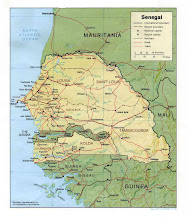
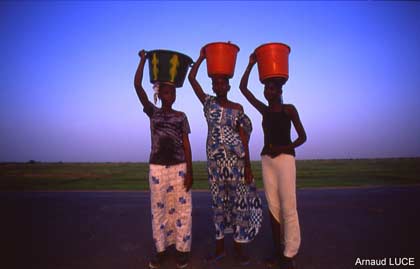
The International Monetary Fund (IMF) concluded recent reviews of Senegal's finances with (for Senegal) high marks for catching up with payments to private contractors. But the April 2 report stressed tough times ahead as the world economy comes to bear.
“Senegal is beginning to experience the effects of the global economic crisis. Main channels of transmission are declining remittances, commodity prices, external demand, and foreign direct investment," according to a statement by Johannes Mueller, IMF Mission Chief for Senegal. He notes positive signs on the horizon: "Declining fuel and food prices are projected to lower inflation to about 1 percent in 2009 and limit Senegal’s import bill, thereby helping contain the external current account deficit."
Despite budget and accounting reforms, falling tax revenues will require deficit spending to continue infrastructure improvments and private contracting, according to the IMF report.
No mention is made of the recent local elections and whether they would chill President Abdoulaye Wade's promotion of intrastructure and private projects. Recently the president reportedly stated his pleas to God that he be allowed to complete infrastucture such as the coastal highway...
Friday, April 10, 2009

France gains Senegal's telecommunications
According to news reports, the government of Senegal has sold its interest in the national telecommunications company Sonatel to France Telecom, making it the majority shareholder with 52.2 percent of Sonatel shares.
The government says it makes Sonatel a better value, but its workers don't think so. They've promised to strike.
Senegal will remain the second largest shareholder in Sonatel with 17.28 percent of the capital. Current Sonatel shareholders gain a premium of 32 percent over the stock price as of April 7, 2009. Thus the government gains 200 billion CFA francs (305 million Euros) without cutting Sonatel's budget.
Thursday, April 2, 2009
How to do it right: German solar engineering in Casamance
In May 2007, the German Ministry of Economics and Technology (BMWi) offered German companies an opportunity to exchange thoughts and ideas with Senegalese partners and institutions. In addition to establishing contacts there, they were also encouraged to present initial business ideas and to develop them further with their partners.
In October 2008, Schott Solar in co-operation with its partners officially began the operation of a solar emergency power system installed with the village inhabitants for a hospital clinic in Baïla, located in Casamance province in southern Senegal.
The clinic in Baïla has an emergency room, a delivery room, 10 beds, a pharmacy and accommodation for family members. Previously, during power outages (not uncommon in Senegal), the staff had to make do with petroleum lamps and candles and, if there was any extra diesel available, the clinic was sometimes able to run a power generator until they were back on the grid.
In this first project, Schott Solar and SMA joined forces with Kaito Energie AG, which had been developing and investing in business-oriented projects in Casamance for several years.
The local electricity network is often overloaded and can sometimes cut off its service several times a day. A five-kilowatt solar power system was installed to supply the clinic with power when the regular network is down. The power from the solar modules is initially stored in batteries. If there is a power outage, the system switches over to a so-called mini-grid with virtually no interruption to maintain stable power, vital to the clinic.
To guarantee the energy supply, Schott Solar donated photovoltaic modules and inverter company SMA donated a ‘Sunny’ back-up system to the clinic in Baïla.
In addition to the solar modules, Schott Solar also provided the system technology and supported the assembly. The installation was completed by the company and its employees. Meanwhile, Kaito Energie AG took responsibility for project management on location and dealt with the local authorities. The village community built the building extension on which the system was installed.
On the roof of the clinic, 102 Schott Solar modules produce approximately eight kilowatt a year--any surplus is stored in batteries.
The modules were transported by ship via Dakar to the regional harbour in Ziguinchor in Casamance, and then taken overland to Baïla. In Casamance, located on the edge of the topical rainforest, climatic conditions are extreme with a great deal of rain.
Following the dry season from November to June, hot monsoon winds herald the rainy season and humid weather from the south. In order to maintain performance, special double-glazed modules were used, based on stainless steel frames which have stood up in Indonesia and Thailand since the late 1980s.
Schott Solar claims its modules meet standards twice that of the IEC 61215 standard: the modules are subjected to temperatures of +85°C and a humidity of 85 percent. During the so-called temperature change test, they have to hold their own against temperature cycles ranging from -40°C up to +85°C. In addition to the solar modules themselves, the power inverter also plays a major role for the operating efficiency and the performance of a solar energy system.
People living in Baïla were also directly involved in the installation of the system. The village community built the extension on which the employees of the project partners mounted the system in May. Trainees from the neighbouring technical college worked with experts from Germany and helped to install the modules on the roof.
German engineering, always awesome to see...
Friday, March 27, 2009
U.S. provides Senegal food assistance
The U.S. Agency for International Development's (USAID) Office of U.S. Foreign Disaster Assistance (OFDA) is providing more than $3.7 million in assistance to lower rates of malnutrition and increase food security of families in Senegal.
Of this $3.7 million, USAID is providing $2.7 million to improve community-based nutrition efforts and agriculture production in the regions of Ziguinchor, Sedhiou and Kolda in Senegal. The program, implemented by USAID partners Catholic Relief Services and Christian Children's Fund, will provide community-based nutrition programs for malnourished children; build community awareness for the importance of good nutrition and how to prevent malnutrition; educate farmers on the benefits of improved seed varieties; organize seed fairs that will make improved seed varieties available; and provide microloans to community-based groups.
Of this $3.7 million, USAID is providing $2.7 million to improve community-based nutrition efforts and agriculture production in the regions of Ziguinchor, Sedhiou and Kolda in Senegal. The program, implemented by USAID partners Catholic Relief Services and Christian Children's Fund, will provide community-based nutrition programs for malnourished children; build community awareness for the importance of good nutrition and how to prevent malnutrition; educate farmers on the benefits of improved seed varieties; organize seed fairs that will make improved seed varieties available; and provide microloans to community-based groups.
Wednesday, March 25, 2009
Shell advances Senegal offshore oil exploration
First Australian Resources (FAR) has signed an agreement with Shell Exploration Company to conduct petroleum exploration of Sangomar Offshore, Rufisque Offshore and Sangomar Deep Offshore blocks off the coast of Senegal,where a number of drilling prospects have already been identified by FAR and its Senegalese partner Petrosen.
The objective of the program is designed to enable Shell to determine whether or not to exercise an option to acquire greater interest in the block and enter the second renewal period that includes a well commitment.
Shell will fund a controlled source electro magnetic (CSEM) data acquisition and geophysical evaluation programme over part of the licence area where a number of drilling prospects have already been identified by FAR. The work gets underway soon.
A more industrious Senegal of late
Senegal produced more finished goods last month over a year ago, according to a recent government report. Construction material production grew, but also textiles and leather.
The National Agency of Statistics and Demography (ANSD) index of industrial production was 105.3 after 101.5 in December 2008, an increase of 3.8 percent, largely upon a surge of industrial production of textiles and leather.
The agency said that production of textiles and leather grew considerably in January2009, a result attributable to an upturn in cotton ginning, in conjunction with the production cycle of the sub-sector.
Sunday, March 22, 2009
Post-election: Whither Wades' world view?
In America the saying is: "all politics are local." But Senegal's elections today, should early results bear out, could also alter the international connections fostered by the damaged President Abdoulaye Wade.
President Wade invested greatly in recent years to make Senegal a player on the world scene, fostering the image of Senegal as the Athens of West Africa, gateway to the region, and a favorite investment of international development. Vis the shine the president put to Dakar for the 2007 conference of the Organization of Islamic States, the port and coastal highway developments, the image of rational African governance as coups and assassinations toppled nearby African governments.
Were today's local election result--largely a drubbing for the Wade SOPI coalition--a repudiation of the president's international marketing efforts? Opposition criticisms focused more on Wade's heavy-handed political tactics, such as the impeachment of legislative leader Macky Sall. His intimidation of journalists could only bring backlash from that estate. (The administration's barely disguised election-day threat to shut down broadcast stations doesn't help there.) Graft, corruption and a bad economy are always a receipe for polling booth rejection.
But other than affront taken in some quarters over the austentious roads and statutes pressed by the Wade regime, the organized opposition hasn't made an issue of Wade's internationalism.
Let's hope that any changing of Senegal's poltiical guard doesn't reverse the world ties that Wade and the country have forged. Senegal's people will benefit through tourism, economic guidance (yes, the IMF does some good), promotion of exports and other international exchange.
In the end, today's election may have little impact on the country's growing world ties. Once again, Senegal's greatest natural resource was displayed by democratic elections with a decent turnout. A people and a government that handle change peaceably, fairly and openly will always find friends and partners around the world.
Subscribe to:
Posts (Atom)