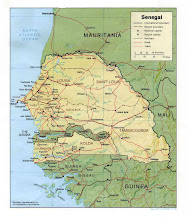
Senegal's infrastructure czar, Karim Wade, son of President Abdoulaye Wade, yesterday told Touba leaders that the government would assist in developing a master plan for the Holy City of the Mourides.
Infrastructure development in and around the fastest growing area of Senegal is already underway, largely done by Chinese construction firms.
The current development work includes developing and maintaining roads and the construction of several water towers and reservoirs.
M. Wade pledged further improvements pursuant to a general plan. "We will initiate a major development plan to Touba to think of tomorrow, the problems of urban development, sanitation and access," he said in Touba.
Monday, January 11, 2010

Monday, January 4, 2010
Update on road bonds
Earlier we posted reports of Senegal government bond sale on the international market. Here is the publicly released letter of Finance Minister Abdoulaye Diop to the IMF seeking an increased debt ceiling:
"To supplement resources from donors and the private sector, the government is mobilizing external funds for the Dakar-Diamniadio toll highway. To this end, the government requests to raise the ceiling for non-concessional borrowing for this project by CFAF 10 billion (less than 0.2 percent of GDP) to CFAF 90 billion. The higher ceiling would allow the government to accommodate possibly higher costs and issue a bond in international markets of $200 million, typically seen as a minimum size for this type of transaction. The small increase would have no negative impact on debt sustainability."
Wednesday, December 30, 2009
Projected growth down for 2010
A bad start for the New Year: Senegal’s economic growth projection for 2010 was lowered by government analysts. Senegal should achieve 3.4 percent economic growth in 2010, down from an earlier official forecast of 4.6 percent, according to the DPEE.
The agency also revised down slightly its 2009 growth target to 1.2 percent from 1.5 percent, after the global economic slowdown hit demand for exports, along with remittances from abroad and foreign direct investment.
"In 2010, growth is projected at 3.4 percent on the assumption of a continued relatively high level of prices for oil products, and the primary sector holding up well thanks to strength in the agricultural sector," DPEE said in a statement. The global slowdown has been worse than expected for Senegal, according to its officials.
Consumer prices, which DPEE estimated dipped 0.4 percent during the course of 2009, should head upwards again in 2010 with inflation of 2.2 percent.
Monday, December 14, 2009
Senegal's first sale of public bonds.
With its fiscal affairs improved by government belt-tightening, Senegal will offer $200 million of five-year bonds yielding about 8.75 percent to finance road building in the West African nation, its first international bond offering. That report is from Bloomberg, which got the news from investors approached to buy the securities.
The relatively small offering is reportedly arranged by Citigroup Inc. With a rally of emerging-market debt since the financial collapse of September 2008, the dollar-denominated debt of developing nations included in JPMorgan Chase & Co.’s EMBI+ Index is trading at 6.595 percent.
Senegal's $13.6 billion economy is rated B+ by Standard & Poor’s, four levels below investment grade.
Saturday, December 5, 2009
Did Dakar help evacuate Camara?
The Times of India reported that wounded Captain Moussa Dadis Camara, head of the military junta ruling neighboring Guinea, was evacuated by Senegalese aircraft. Other news reports have filled in some details of the assasination attempt on Camara. Apparently the chief of his presidential guard insisted on the release of his troops, jailed by Camara as a result of the September massacre of democracy protesters in Conakry. He shot Camara, according to current report, when the matter got heated between them... It gets personal in Guinea.
Sunday, November 29, 2009
Thiès: Iran's Detroit? Or Detroit's future?
In a swing through Dakar on his five-county friendship tour, Iran's President Ahmadinejad reiterated his country's support for Senegal's nascent auto industry in Thiès. The Iranians now promise to set up a tractor production factory in Senegal in the near future. Iran's automobile manufacturer, Iran Khodro Company, is partner in the SenIran factory, making the Samand sedan designed by Khodro. "With completion of the factory in Senegal, this country can export its cars to other regional countries," Ahmadinejad said.
I thought the Thiès plant was fully operational. Maybe not. The Wall Street Journal's recent article reported that the Iranian-Senegal joint venture was having trouble getting cars built. But maybe manufacturing still needs to be constructed.
According to Fars News Agency, Iran Khodro is the largest carmaker in the Middle East, Central Asia and North Africa regions with annual production of more than one million various vehicles including cars, trucks and buses.
Meanwhile... Apparently the Chinese will see if they can do better than the Indians when it comes to making Senbuses. Remember that Tata, the Indian manufacturing giant, also set up a factory in Thiès to build 500 "Senbuses," public conveyance intended to replace the colorful vehicles that served Dakar for so long, and are sure to be missed.
So now King Long, a Chinese outfit, subsidized with a $25 million loan from the Chinese government, has taken over the Tata operation, still in "partnership" with the Senegalese.
"I want to make Thiès the industrial capital of Senegal,” Senegal's President Wade decreed recently during a ceremony there for the new partnership.
Alas, an industrial infrastructure takes more than a government decree. And Senegal has not shown that it has whatever it takes yet. We'll see if the new Chinese-Senegal venture does better than the Iranian-Senegal venture or the Indian-Senegal venture... Maybe what it takes is the entrepreneurial, techno-savy capitalistic hussle that can only be found, where else: Detroit where are you? It's not like you have anything better going on back home.
Wednesday, November 18, 2009
Big order for Senegal Airlines
Airbus said Wednesday that Senegal Airlines, the new national carrier of the Republic of Senegal, has signed a letter of intent for four A320 aircraft and two A330 aircraft.
Airbus, a wholly owned unit of European Aeronautic Defence & Space Co., didn't give a value for the deal, but it is worth approximately $700 million, according to list prices.
Senegal Airlines will start operating early next year from its hub in Dakar to destinations in Africa. It will replace Air Senegal International, according to a statement released at the Dubai Airshow.
Subscribe to:
Posts (Atom)